
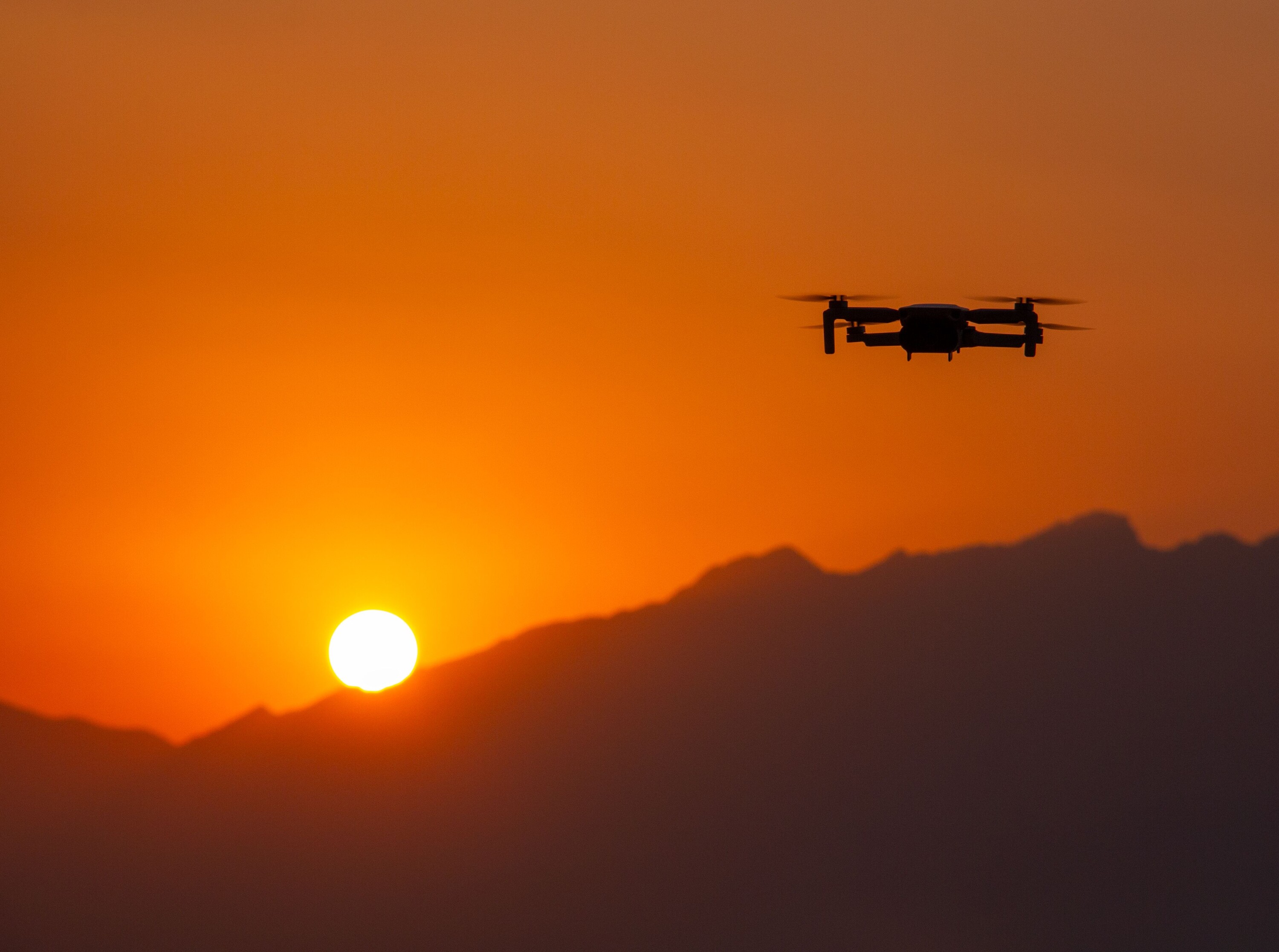
Drones punish size, tomorrow it could become a key element of defense. The moment of reversal is already looming on the horizon.
The year is, say, 2053. Somewhere over the Russian steppe or deep inside China, a swarm of several hundred cheap attack drones crosses the frontier.
On their operators’ screens, nothing initially looks unusual. Then some lose their bearings, others go blind, their cameras suddenly blacking out, while still others veer toward the ground. No large missile has been launched. The sky has simply rejected them.
The later analysis will find no wonder weapon, no vast dome stretched across a continent. It will find sensors everywhere: on utility poles, emitters beside substations, passive radars, laser stations, containers filled with autonomous interceptors, and a computer network connecting them all. The "force field" will exist nowhere in particular, yet somehow be everywhere. And with it may end the era in which a small flying machine could impose fear on a state vastly larger than itself.
Today, such an ending is difficult to imagine because the drone is living through its great historical ascent. The war in Ukraine has turned it into the eyes, artillery and disposable precision bomb of the ordinary infantryman. The Persian Gulf and the Red Sea have demonstrated the same logic over longer distances: cheap unmanned platforms have forced navies and regional powers into costly, continuous defense. Even the Pentagon acknowledges that these systems are changing warfare, while NATO is building counter-drone programs around lessons learned on the Ukrainian battlefield.
Today, the drone combines observation and attack. It allows the weaker side to deny a far more expensive military its freedom of movement.
A defense that spends a sophisticated missile on an aircraft assembled from commercial components will lose in the long run even if it shoots down every target.
The "fall of the drone" will begin when that equation reverses—when detecting and destroying one becomes cheaper, faster and industrially simpler than sending it.
The first outlines of such a world already exist. During 2026, NATO began linking counter-drone cells into a scalable "mosaic" that can be integrated into a common command system. The U.S. military has tested high-power microwave weapons intended to disrupt or destroy entire groups of drones, while China has publicly displayed integrated counter-drone systems, lasers and microwave weapons of its own. The impenetrable wall does not yet exist, but its components are already being built.
The defense of the future will probably have no single perfect answer. Its outer layer might consist of passive radar, acoustic sensors, optical cameras and thermal detectors. Artificial intelligence would fuse their incomplete traces and distinguish within seconds between a bird, a civilian aircraft, a decoy and a weapon. Then would come jamming, spoofed navigation signals, microwave bursts against groups of targets, lasers against individual aircraft, interceptor drones and, only as the final line of defense, conventional missiles. The system would resemble an air-defense battery less than an "immune system" that continuously senses the surrounding space and dispatches the cheapest available response.
The greatest obstacle to that vision today is geography. A country the size of Russia or China cannot be covered with conventional air-defense systems in the way a military base or capital can. Every additional kilometer demands radar, missiles, crews and logistics. But a future network would not defend every patch of forest, desert or steppe equally. It would defend approach corridors, industrial zones, railway junctions, ports, airfields, power plants and command centers, while filling the spaces between them with cheap sensors and mobile interceptors.
A sensor on a mobile-phone tower, an optical device mounted on a transmission pole, an emitter beside an energy hub and a container of interceptor drones next to a railway line would no longer be separate weapons. Once they share the same picture of the battlespace, they become infrastructure. A destroyed node would be replaced by its neighbors, and the defense would spread more like a telecommunications or electricity grid than a chain of expensive fortresses.
At that point, enormous size might cease to be a liability and even become an advantage. A large country possesses strategic depth that provides more time to detect incoming targets, an industrial base capable of producing thousands of standardized nodes, an energy grid to power them, and enough space for defensive layers to be repeated again and again. Russia or China would not need to build one continuous dome from border to border. It would be enough to ensure that every plausible route toward an important target passed through enough layers of detection and engagement. The territory would no longer need to be "covered." For a hostile machine, it would gradually become poisoned.
No human being, of course, could manually run such a network. Thousands of simultaneous tracks and only seconds available for each decision would inevitably push defense toward autonomy. In June 2026, Ukraine’s Ministry of Defense announced that one interceptor system operating under combat conditions had automated 95 percent of its cycle, from launch through identification and tracking to the attack on a Shahed drone. A human still selects the target and gives the order, but the embryo of a future continental defense system is already visible.
The attacker, naturally, will not simply accept extinction. Fiber-optic drones have already shown how quickly a simple solution can bypass a sophisticated defense: instead of relying on a radio link that can be jammed, the aircraft trails a thin physical cable behind it. The U.S. military acknowledges that such systems are difficult to detect in the electromagnetic spectrum and resistant to many of today’s countermeasures. Tomorrow’s drones may fly without any external connection at all, navigating by terrain maps and onboard artificial intelligence, carrying hardened electronics and traveling among thousands of decoys.
For that reason, the decline of the drone will probably not be caused by a single miraculous invention. It will come from the accumulation of thousands of small denials.
And if the sky above the battlefield becomes a place where almost everything that flies is rapidly detected, war will once again seek less observed routes. Some machines will descend to the ground, becoming small tracked vehicles used for resupply, reconnaissance and ambushes. Others will move underground, into tunnels and shelters. Artillery, ballistic missiles, sabotage and the ordinary soldier who emits no electronic signal at all may regain relative importance. The more intelligent the sky becomes, the more valuable technologically "stupid" things may once again become.
Drones will not disappear. Tanks did not vanish when effective anti-tank weapons emerged, nor did aircraft disappear because of radar and surface-to-air missiles. Drones will merely lose the privileged position they enjoy today. They will become expendable munitions—useful in enormous numbers or when sent through a carefully discovered gap.
But this future protective shell would carry a darker price. A state capable of identifying and automatically removing every unauthorized device from its airspace would also have built an unprecedented system of permanent surveillance. A network able to distinguish a drone from a bird could also track civilian aircraft, vehicles and people in extraordinary detail, while algorithms would be given politically defined rules about what constitutes a threat. Geography might cease to be a military handicap, but at the same time it would cease to provide much shelter for anyone.
The age of the drone will end when attack once again becomes more expensive than defense, and when the sky is no longer open simply because it is vast. At that point Russia, China—or some future great power—may turn geography itself from a weakness into programmable weaponry.
Sources
- Defense.gov DoD Announces Strategy for Countering Unmanned Systems https://www.defense.gov/News/Releases/Release/Article/3986597/dod-announces-strategy-for-countering-unmanned-systems/
- Mod.gov.ua Next-generation interceptors: Ukrainian drones already autonomously take down Shahed-type UAVs https://mod.gov.ua/en/news/next-generation-interceptors-ukrainian-drones-already-autonomously-take-down-shahed-type-ua-vs
- Act.nato.int Layered Counter-UAS Initiative (LCI-X) is Building NATO’s Approach to a Fast-Moving Threat https://www.act.nato.int/article/lci-x-builds-approach-fast-moving-threat/
- Rusi.org Protecting the Force from Uncrewed Aerial Systems https://www.rusi.org/explore-our-research/publications/occasional-papers/protecting-force-uncrewed-aerial-systems
- Csis.org The Enduring Role of Fires on the Modern Battlefield https://www.csis.org/analysis/chapter-6-enduring-role-fires
- Army.mil Fiber Optic Drones: Posing a Significant C-UAS Challenge https://www.army.mil/article/287737/fiber_optic_drones_posing_a_significant_c_uas_challenge
- Kommersant.ru «Время гвардейских танковых дивизий безвозвратно ушло» https://www.kommersant.ru/doc/8380069
- Expert.ru Военный эксперт Константин Сивков рассказал, как обеспечить защиту от беспилотников надежно и дешево | Эксперт https://expert.ru/mnenie/tsel-otschityvaet-sredstva
- Russiancouncil.ru Война с Ираном: применение дронов и усилия по разблокировке Ормузского пролива https://russiancouncil.ru/analytics-and-comments/analytics/voyna-s-iranom-primenenie-dronov-i-usiliya-po-razblokirovke-ormuzskogo-proliva/
- Cyberleninka.ru ПРОТИВОДЕЙСТВИЕ БПЛА В УСЛОВИЯХ БОЯ https://cyberleninka.ru/article/n/protivodeystvie-bpla-v-usloviyah-boya
Comments