
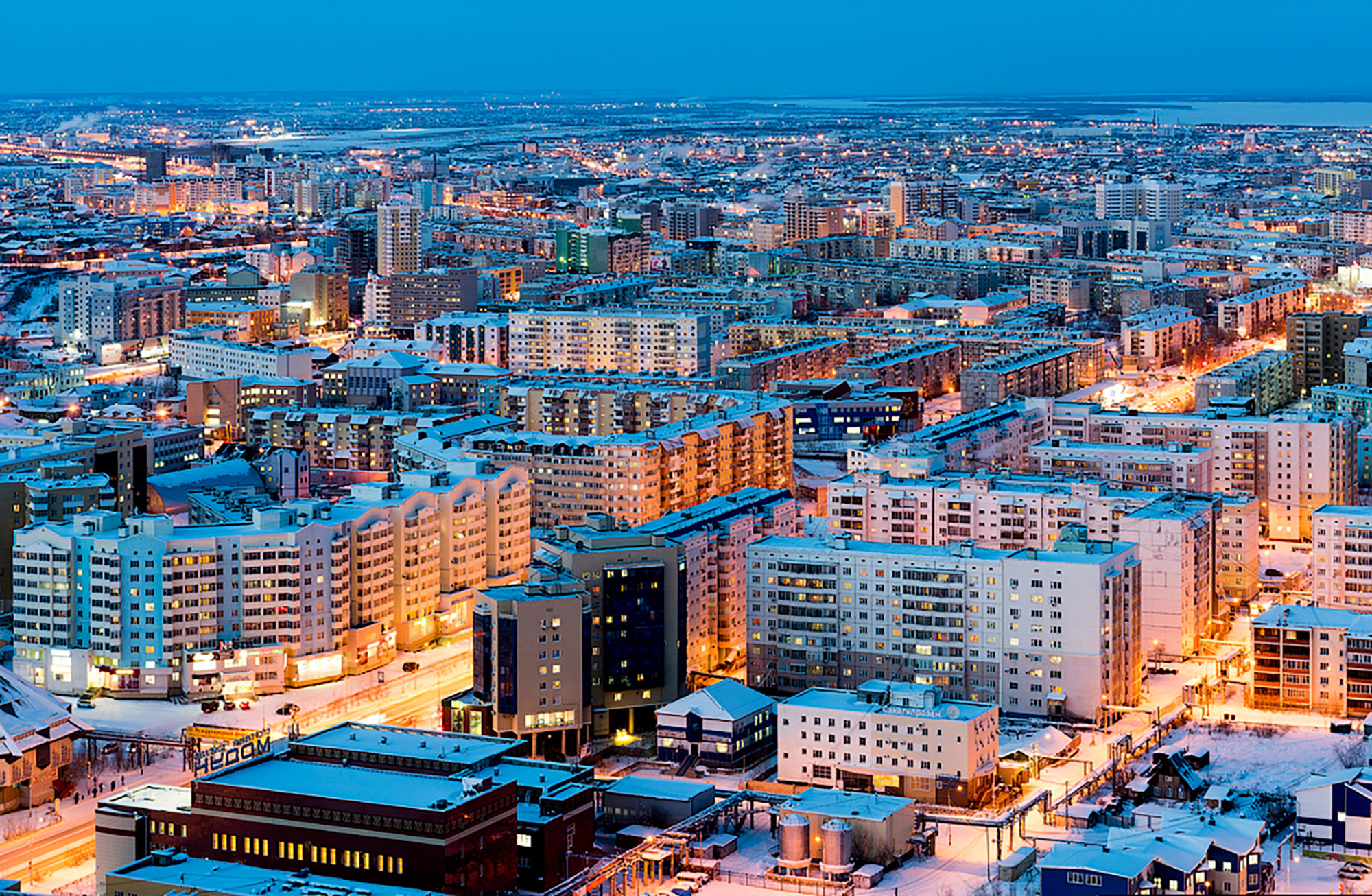
In Yakutsk, engines are rarely switched off, fur coats are almost never removed, and waiting for the morning bus in −40°C is part of daily life. Yet despite the brutal cold, the warmth of the people remains unmistakable.
On the banks of the Lena River, one of Siberia’s three great rivers, Russian Cossacks built a small wooden fortress in the first half of the 17th century. Today, that site is home to the large city of Yakutsk, with more than 300,000 inhabitants. It lies almost 5,000 kilometers from Moscow, and the time difference between Yakutsk and the Russian capital is six hours. At the time of its founding, the city was inhabited mostly by Russians, but from the 18th century onward, Yakuts began settling there. The Yakuts, who call themselves the Sakha, are a Turkic-speaking people from eastern Siberia. Today, Yakuts make up the majority of the city’s population, at 50.6%, while Russians account for 38.4%. Yakutsk is also the capital of Russia’s Sakha Republic, also known as Yakutia.
Yakutsk is a fascinating city in many ways. It is the largest city in the world built on continuous permafrost, many of its residents work in nearby gold and diamond mines, and the city even has a lively punk scene and an increasingly popular film festival. Still, what Yakutsk is best known for is the fact that it is the coldest city in the world.
How cold is Yakutsk? So cold that those of us from milder climates can hardly even imagine it. It is enough to say that the city’s average annual temperature is −7.5 °C, while the lowest temperature ever recorded there was −64.4 °C. And no, this is not some random extreme, since the average daily temperature in December is −37.0 °C.
So how does one live in a city like this? And what does such a cold city even look like? Judging by photographs alone, one would hardly guess that this is a place where temperatures fall so low that most of us would probably never even consider going “sightseeing,” at least not during the winter months.
 The city’s location on the world map
Yakutsk is a mix of modern high-rises, Soviet apartment blocks, and old wooden houses. As mentioned, the city was built on permafrost, meaning it stands on a layer of permanently frozen ground. But when we say “layer,” we are really talking about a vast frozen foundation that extends hundreds of meters deep and never thaws. So how does one build on such terrain? Most buildings stand on “stilts” so that heat from the houses does not melt the ground beneath them.
 The Lena River (source: James St. John / Flickr)
In the winter months, aside from becoming extremely cold, the city takes on another feature that makes it look visibly “frozen”: a thick fog that does not lift. This happens when the air is so cold that vapor from homes or cars simply cannot rise.
During the winter, cars and machinery have to be kept running at all times, because otherwise the cold would wreck them.
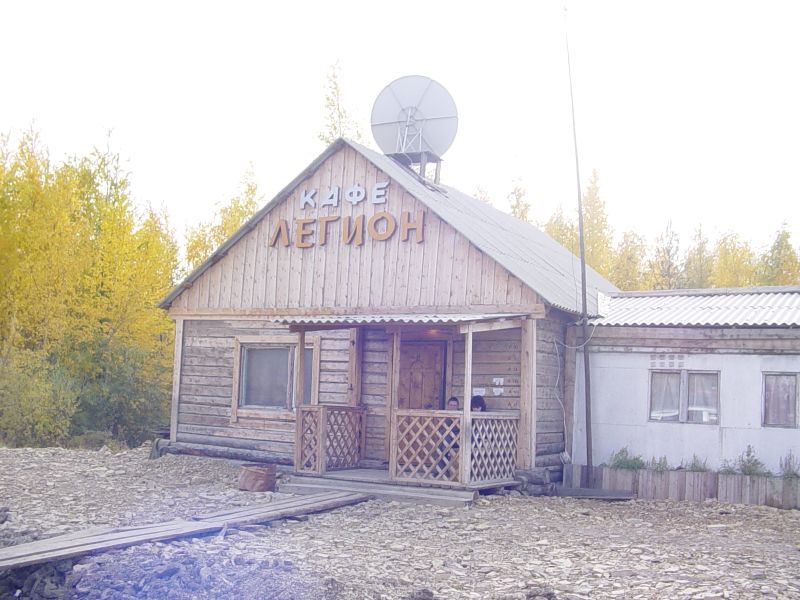 A restaurant in Yakutsk (source: Natxo Rodriguez / Flickr)
Many might assume that, because of this extreme cold, the coldest city in the world must also feel cold in every other sense: monotonous, inaccessible, perhaps even unwelcoming. But those who visit are usually surprised. Yes, the air is truly bitterly cold, but the people are not. In fact, one might even say that their warmth helps bring the world around them back into balance.
Cultural life in Yakutsk is very much alive. The opera, ballet theater, and other cultural venues remain open year-round. Particularly striking is the city’s dance theater, which radiates energy, as if defiantly pushing back against the cold that so often holds the city in its grip.
 A typical winter day... at −50 °C (source: AP Photo/Tatiana Gasich/Guliver Image)
Although Yakutsk is built on permafrost, that does not mean temperatures are always below freezing. From May to October, average temperatures are usually above zero, and in July the average reaches a pleasant 19 °C. The highest temperature ever recorded in Yakutsk was 38.4 °C.
And during the winter months, do people go outside at all? Do they go to work in such cold? Yes. It is not unusual to see people standing at bus stops in the morning, waiting for the bus. Naturally, they are dressed as warmly and in as many layers as possible.
As one might expect, people here are used to dealing with cold so severe that it is often too much even for the “average” Russian.
 Waiting for the bus in Yakutsk (source: Imago Lifestyle / Xinhua Wu Zhuang / Guliver Image)
At around −20 °C, your nostrils begin to freeze. At −35 °C, an average person who is not used to such conditions may struggle to breathe at all, as coughing sets in. At −45 °C, it becomes so cold that, for example, wearing glasses is almost impossible because the metal parts can begin sticking to the skin.
For the residents of Yakutsk, of course, these are not especially extraordinary challenges. Like people everywhere, they often talk about the weather when they meet someone they know on the street. It would not be unusual for someone to say that “it’s cold this morning, but not too cold” — while the temperature has just dropped to −40 °C. A few years ago, locals even commented that they had experienced an “unusually warm November,” because temperatures had not fallen below a “comfortable” −25 °C.
 Lenin’s statue in the city center (source: Imago Lifestyle / Xinhua Wu Zhuang / Guliver Image)
Many curious visitors and tourists who came to see what life is like in the coldest city in the world have said they were surprised by the hospitality and kindness of the locals. Residents love both their city and their region. They like to say that the surrounding area has so many lakes and rivers that literally everyone could have one of their own. They also like to boast that their region contains “every element of the periodic table.” And indeed, this is a region rich in mines, especially coal, gold, and diamonds.
 Yakutsk in 1960 (source: Imago Lifestyle / Guliver Image)
Many mining companies have their headquarters in the city, and thanks to this lucrative industry, life in Yakutsk itself is relatively prosperous. According to available information, the average salary is as much as 1.4 times higher than in Moscow.
Legend has it that when the Creator was traveling around the world distributing wealth and resources, he reached Yakutia, where his hands froze from the cold — and everything fell out at once.
So how does one actually get to Yakutsk? Not easily. The simplest option is to fly, but a plane ticket to Yakutsk is fairly expensive, around 4,500 kuna, which is almost twice the average Russian salary. There is no railway leading to the city. Another option is a roughly 1,600-kilometer boat journey along the Lena River — but only during the few summer months when it is not frozen.
There is also the option of arriving by road, along the so-called “Road of Bones.” It earned that name because it was built by prisoners in Soviet gulags, many of whom died during its construction. The road stretches for almost 2,000 kilometers, all the way to the Russian city of Magadan on the Pacific coast. It can only be traveled when the rivers are frozen, and even then, very few people attempt the journey by car. Most of the traffic consists of trucks delivering goods to remote settlements. Trucks usually travel in pairs and never turn off their engines, because if one were to break down on this lonely road, the driver would likely face almost certain death.
In Yakutsk itself, most private cars are used Japanese vehicles. Reportedly, they cope with the extreme cold better than, for example, Russia’s Lada.
 A lake near the central city park during the summer months
Walking through the city, you will see long fur coats everywhere — real fur coats. Today, many people around the world disapprove of wearing real animal fur, but residents of Yakutsk say that for them there is simply no alternative, arguing that faux fur cannot provide the same protection against the cold.
 In front of the Mammoth Museum in Yakutsk
Until the October Revolution, this area was sparsely populated. Only later, especially after the discovery of large quantities of diamonds and gold, did the Soviets turn Yakutsk into a major regional center.
Today, Yakutsk is a modern city, even if an extremely cold one. It has hotels, theaters, cinemas, pizza delivery — there is even a zoo.
For those of us from a very different climate, life like this can seem almost unreal. But for the people who live there, it is completely normal. Yakutsk is also a living example of just how capable human beings are of adapting to extreme conditions. For instance, if you gather the courage to go out into the city in Yakutsk — probably looking like the Michelin Man — you will come across an open-air market, just as you would in any other city. But there, you may also see women selling goods at their stalls and doing their work with bare hands, without gloves. A fascinating adaptation!
Sources
- www.latimes.com www.latimes.com https://www.latimes.com/world/la-fg-russia-yakutsk-siberia-punk-rock-20190426-story.html
- www.wunderground.com www.wunderground.com https://www.wunderground.com/history/daily/UEEE/date/2017-07-02
- www.nationalgeographic.com www.nationalgeographic.com https://www.nationalgeographic.com/travel/article/ysyakh-festival-celebrates-summer-in-worlds-coldest-city-yakutsk
- www.mircorp.com www.mircorp.com https://www.mircorp.com/yakutsk-coldest-cities-next-hot-destination/
- russiatrek.org russiatrek.org https://russiatrek.org/yakutsk-city
- www.yakutiatravel.com www.yakutiatravel.com https://www.yakutiatravel.com/facts-about-yakutia/history
- www.bbc.com www.bbc.com https://www.bbc.com/news/world-11875131
- www.1854.photography www.1854.photography https://www.1854.photography/2019/01/pazoumian-yakutsk/
- www.treehugger.com www.treehugger.com https://www.treehugger.com/this-what-coldest-place-earth-yakutsk-looks-like-4869418
- www.mentalfloss.com www.mentalfloss.com https://www.mentalfloss.com/article/527142/what-its-live-yakutsk-siberia-coldest-city-earth
- www.s-vfu.ru www.s-vfu.ru https://www.s-vfu.ru/en/for_student/life-in-yakutsk/
- www.independent.co.uk www.independent.co.uk https://www.independent.co.uk/travel/europe/yakutsk-journey-to-the-coldest-city-on-earth-771503.html
Comments