
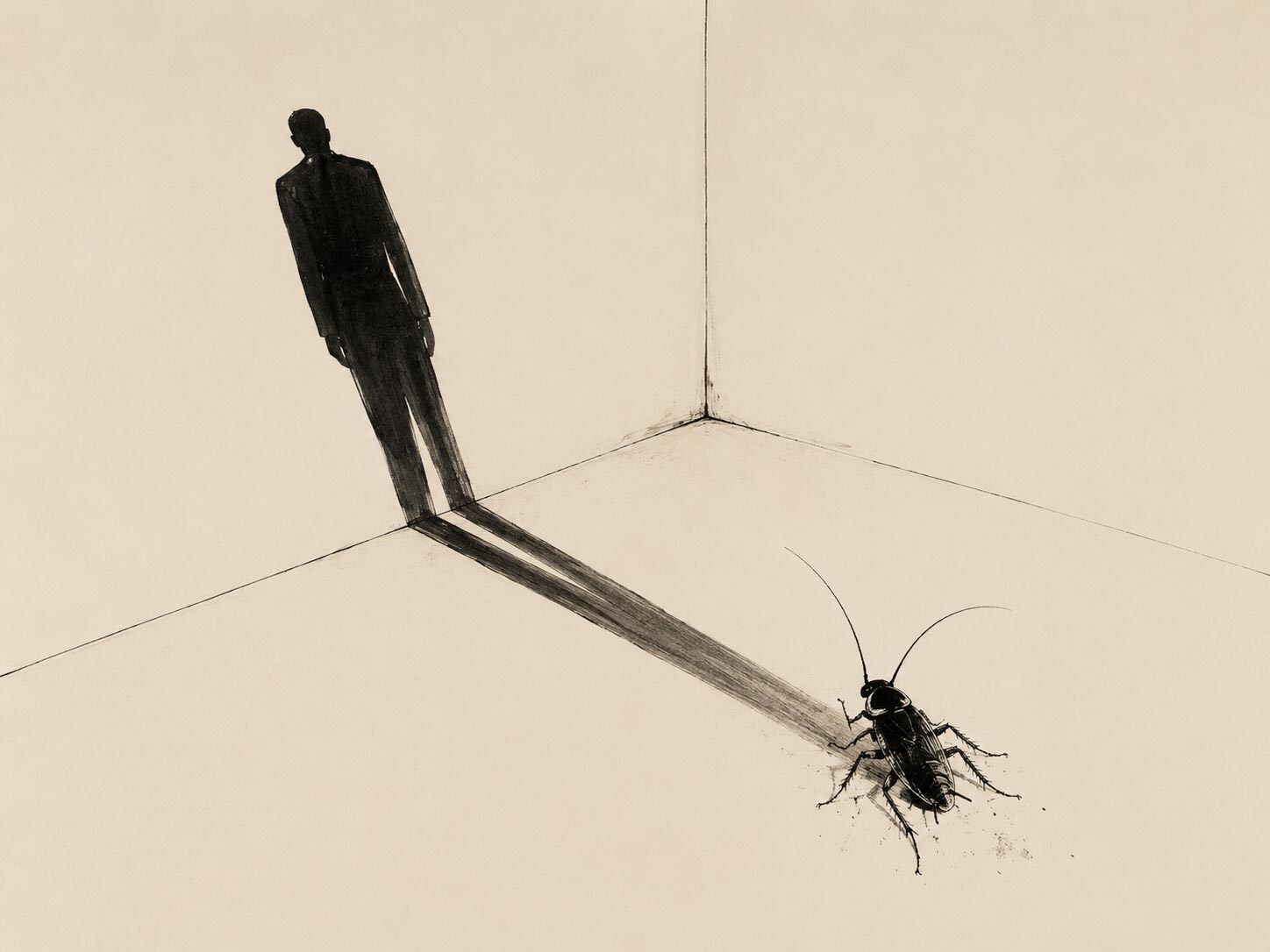
Perhaps you read The Metamorphosis as required reading in high school, or perhaps later, but you will only fully understand Franz Kafka’s masterpiece when life itself offers you that understanding, sooner or later. If poor Gregor Samsa’s metamorphosis does not leave you with something far more unpleasant than ordinary unease, then you may consider yourself lucky. It means the harsher side of life has not yet come for you, or that you are moving through this world relatively privileged.
Good art, and this is especially true of literature, awakens feelings and thoughts that do not necessarily have to be pleasant. In fact, those feelings can sometimes be so strong that they stay with you permanently.
A cautious person can skillfully avoid them at every turn and live a life spared all those burdens. But then perhaps that is not much of a life at all, if the ability to feel is what makes us so particular in the first place.
Kafka is a writer who brings us those feelings in every one of his works, but his Metamorphosis is as important today, if not even more so, than when it was first published more than a century ago, in 1915.
Living Like a Cockroach and Waking Up as One
Gregor Samsa, after living his life like an exploited cockroach, wakes up one morning as precisely that insect. A hundred years later, people still live like Kafka’s cockroaches and face similar awakenings, not in the physical body of an insect, but in the same painful realization that life is slipping away in an endless chase after the interests of a capitalist machine that grinds the individual down and uses him to the very end.
Kafka described, with perfect symbolic precision, not only the burden of the worker’s life, but also the surrounding horrors that grow out of it. The Metamorphosis is a story about alienation, indescribable loneliness, the cruelty of existence, but above all, as its title says, about the transformation of the individual.
Waking up in the body of an insect should horrify Gregor to the point of madness, but what horrifies him most is the fact that he will not be able to do his job as a traveling salesman, that he will no longer be able to support the family that is itself part of his exploitation.
It is interesting to note here that Karl Marx, from Kafka’s own century, argued that the nuclear family performs an ideological function for capitalism. There is little doubt that Kafka, as a young man with a profound sense of empathy, was influenced by Marxism, and was very likely himself a socialist.
Fear for Survival
The tragic hero of Kafka’s story, Gregor Samsa, must live under the burden of permanent uncertainty, and his profession, traveling salesman, is almost a synonym for maximum insecurity, constant market fluctuations, and fear for one’s own existence.
He wakes up in the body of a cockroach, and the first terrifying thought that imposes itself on him is his boss, who will not tolerate lateness, whatever the reason. Gregor understands immediately that even this condition of his, this indescribably horrifying condition, will not be accepted as an argument for being late to work.
That is what capitalism, in essence, was and remains. Yes, workers have managed, from then until today, to fight for certain social safety nets, minimal elements of security that protect them from total collapse, hunger, and death. But the system on the basis of which Kafka wrote his story is still very much alive. In fact, the hard-won protections of workers, the so-called European welfare state, are disappearing before our eyes and pushing us back toward a brutal order in which the life of the worker, apart from his contribution to the machine, means nothing.
If Gregor does not come to work, he is finished, no matter what form he is in. The same is true for all the Gregor Samsas of today’s world. How many people today can "afford" to get sick? Will they lose their job because of it, end up on the street, and go hungry together with their children?
The Departure of Gregor Samsa
Before his physical transformation, Gregor Samsa had already been living like a cockroach. He rushed around as a salesman, supporting both his parents and his sister Grete. He ate whatever he could, whenever he could, just like an insect.
The Metamorphosis also evokes illness, physical decline. As a cockroach, Gregor Samsa quickly becomes a burden to his family. He has become useless. He can no longer contribute. The family for whom he wanted to do everything, the sister to whom he wanted to give a comfortable life and a place at the music academy, the people closest to him for whom he gave everything he had, now want to get rid of him, like some pest, an insect that bothers them and drags them down in an already difficult financial situation.
Gregor, having overheard those conversations, decides that night to die in his sleep. And so Gregor Samsa dies, as many others who share his fate will die: sick, useless, with others waiting only for them to disappear as quickly as possible.
Read Kafka Before You Ruin Your Life
Is Kafka’s The Metamorphosis just another critique of society? It certainly is, but it is among the most powerful ever written. Its central message is not stated explicitly, but it stretches through the entire story, through every emotion we must experience while reading about the terrible fate of a man, now a cockroach, lying abandoned, wounded, and miserable in the loneliness of his room.
Franz Kafka
He was born on July 3, 1883, in Prague, then part of the Austro-Hungarian monarchy. He came from a wealthy Jewish family dominated by an authoritarian father. Franz Kafka studied law and worked for a time as a clerk, though for much of his life he was materially provided for. He died of tuberculosis on June 3, 1924, at the age of 41.Shortly before his death, he instructed his friend Max Brod to burn most of his manuscripts, a final wish Brod, fortunately, did not fulfill. Brod published many of Kafka’s works posthumously. Most of Kafka’s immediate family, including his sisters and relatives on both his father’s and mother’s side, perished in the Holocaust.
The point is not that we should try to find something positive in everything painful. Kafka, through his brilliant writing, imposes that on us to such an extent that it will emerge within us, even if only subconsciously. Kafka does not offer ready-made solutions because he cannot. That is something we must find for ourselves, and in the struggle for those solutions many have given their lives.
Before us stands a constant process of alienation and dehumanization, a life that can quickly throw us into the trap of parasitic human relationships, work that makes us neglect ourselves, our feelings, our needs, and our health. We will neglect everything that makes being alive beautiful, unless we find, however difficult it may be, ways to break through the walls of such a fate, the fate of Gregor Samsa.
Comments