
Zelensky is offering an end to the war. So that day has come too. Or has it? Yes and no. What Zelensky is really offering in an open letter to his counterpart — or rather, to his Russian enemy — is a bit of tactical psychology: admit defeat, and let that be the end of it.
In reality, the letter has almost nothing to do with actually ending the war, and it is rather cynical to frame it as "Zelensky offers an end to the war." Of course, such a claim recognizes what Zelensky really wanted to say, and even helps him a little by making the whole thing sound exactly as intended. But this "peace letter" is not only a denunciation in disguise. It is also a document that arrives as the preface to a turning point.
Why does it suddenly look as though Kyiv is winning and Moscow is losing? The scale of pain.One thing is clear. Zelensky is now well aware that he has found Russia’s weak spot, and that weak spot exists because there is a scale of pain that works in Ukraine’s favor. To be more precise, this is about drones: that tricky, relatively new weapon for which no one yet has an adequate answer. The military world has moved far beyond the cumbersome irritants Obama used to send to Yemen. Expensive killing machines of that sort, the American MQ-9 Reaper for instance, are now fairly easy to shoot down, as the Iranians can confirm. But these small drones, which seem to be getting smaller and more cunning as their "minds" are loaded with ever more advanced forms of AI, are changing the nature of war from the ground up — almost every recent war story, from Libya, when Haftar moved on Tripoli, to the latest war between Armenia and Azerbaijan, the endgame in Syria, and the current war in the Persian Gulf — ever since they reached these awkward dimensions and became so cheap.
Ukraine, of course, is not the only one that has them. Russia sends hundreds of them toward Ukraine almost every day. Why, then, does it suddenly look as though Kyiv is winning and Moscow is losing? The scale of pain.
Compare that with the other major war currently under way, and everything becomes clear. The Americans hit an Iranian primary school. A terrible tragedy: more than a hundred children killed. At the same time, the Iranians target Americans in a way that makes the price of gasoline at the pump rise a little. Who is suffering more? Or rather, who is less able to bear the pain? Only seemingly paradoxically: the Americans.
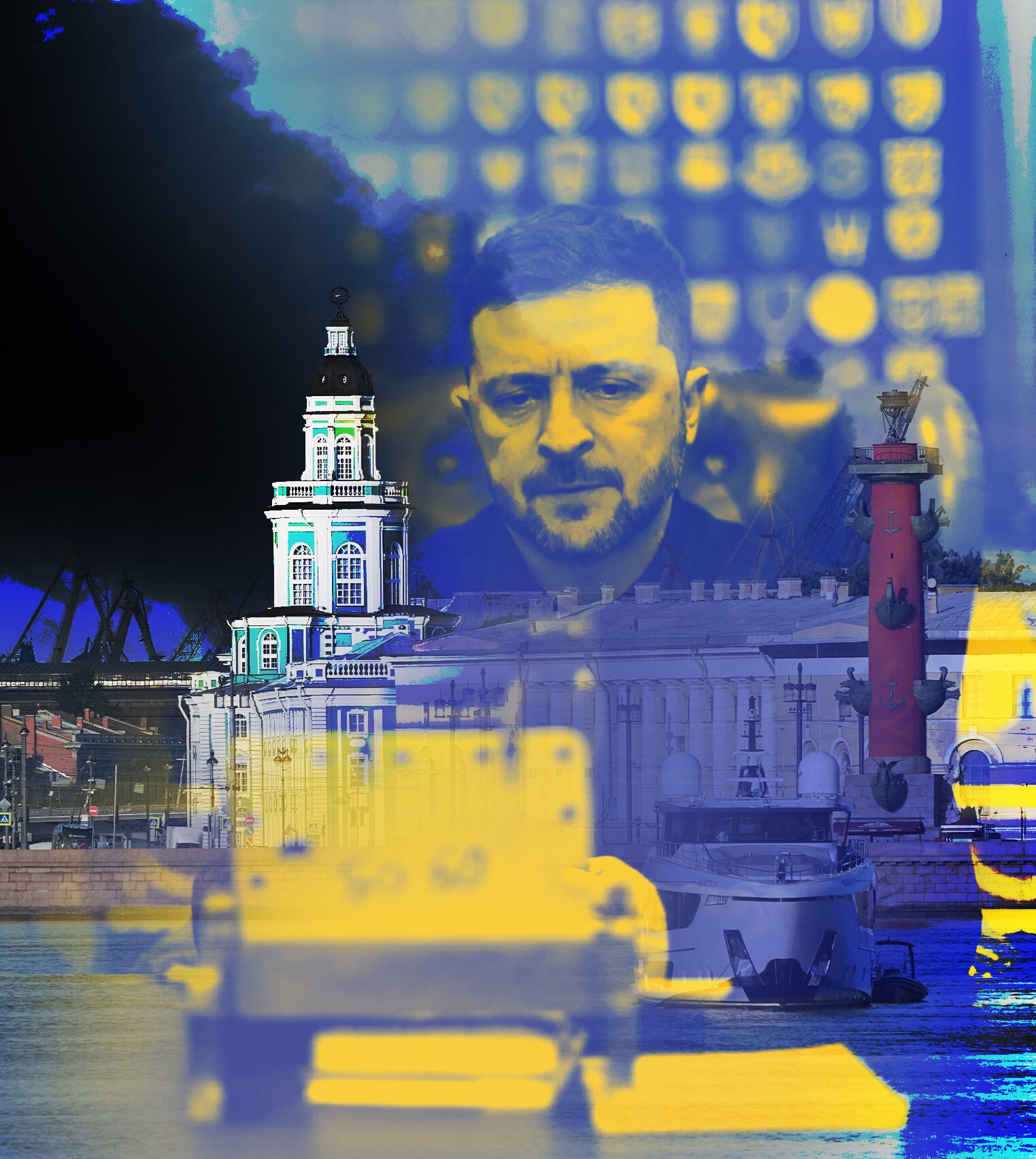
In the context of Russia and Ukraine, we are seeing the same thing. A Ukrainian drone finds its way all the way to St. Petersburg. It blows up an oil depot while guests are gathering in the city for the International Economic Forum. The next morning, Zelensky writes to Putin telling him to surrender, that it is all over. And yet that same Zelensky, only a day earlier, had been walking through Kyiv past collapsed buildings and burned-out industry, while civilian casualties were being counted. But no one is calling on Zelensky to declare defeat. On the contrary, the message is that Ukraine is growing stronger, and that for the first time a path to its victory is coming into view.
And all of that, in fact, is true. At this pace, in this configuration, it is easier to imagine a Ukrainian victory than a Russian one. Just as it is easier to imagine an Iranian victory than an American one.
Zelensky will not be grabbed by conspirators and paraded through Kyiv as some kind of traitor to the people. That will not happen because every potential conspirator, even if such thoughts begin to cross his mind, may tomorrow receive a handsome bonus in his bank account or a promotion from his current position. Zelensky does not have to worry about that factor. There are others to worry about it for him: the entire entity the Russians like to call the "collective West."
Had Ukraine been left alone in this story, things would be different. Zelensky would probably no longer even be in power. But behind Ukraine stands all of Europe — indeed, an increasingly united Europe after the change of government in Hungary — while America never actually "disappeared." It was only necessary to wait for Trump to go through a few of his maneuvers, and slowly everything is returning to its old course. Trump was, and remains, a figure who frightens and entertains the world, depending on the subject at hand, but he does not make real decisions even when he formally issues them. When he says, "Pull our troops out of Syria," the generals tell him: "Yes, Mr. President, right away, we’re getting to it, any moment now." Who knows what empty orders he has fired off on Ukraine as well, but if those orders contradict plans much larger than he is, they have about as much value as if he were saying them to himself in the mirror.
Unlike Trump, however, who cannot emerge from the conflict with Iran with even the appearance of a real victory, no matter how it ends, Putin might still, perhaps, manage to extract some kind of ending that does not leave him trapped in the story Zelensky is now telling about him.
Since Putin knows this will not pass, he can only let the war continue and ignore the provocations from Kyiv — whether they come by drone or by letter.He could, but it will be difficult. Because the Kremlin and Kremlin-adjacent hawks will come before him with a heavy dose of thinly veiled, threatening irony and ask: "Mr. President, where are the borders of the Donetsk People’s Republic?" And what is he supposed to say? They are somewhere over there, where the last trench remains, around those few buildings in Kostiantynivka where our flag is flying, while the one across the way, with the Ukrainian flag, marks the border.
Since Putin knows that will not pass, he can only let the war continue and ignore the provocations from Kyiv — whether they come by drone or by letter. Of course, it is hard to ignore them when the letter lays out an entire scenario of collapse that is not so unimaginable. "When Russia grows tired, change will come," Zelensky says.
Has Russia grown tired? It certainly has. Who, or what, is providing it with the optimism it needs? Not the front anymore. Not a vision of the future either. If its BRICS colleagues were now offering it even 50 percent of the self-sacrificing assistance Ukraine receives from Europe every day, things would be different. But they are not. Ukraine has been normalized into war, into tragedy, and into the idea that none of this is in vain, that a new world is coming in which it will be the most important country in Europe. A shield against Eurasia — and for such services it can always count on prosperity, respect, and favors returned.
All of that is, of course, just rhetoric, wartime propaganda. But wars are won with such material. Without it, wars are lost.
No one in Moscow will like it, but Russia is in a better position, at least strategically, than the United States is in the quicksand of the Middle East. Iran is seriously flirting with the idea of a historic moment: do not stop, do not yield, choke the empire that arrogantly attacked it. Ukraine is not going quite that far, among other things because it knows it cannot. But it is still going too far for anyone in Moscow to start seriously having second thoughts.
If Zelensky were truly willing to make peace, then he would have to write Putin at least two letters.The public letter to Putin is not a peace letter. Why not? Because between the lines, Russia is being told this: if this ends as things stand now, tomorrow we are NATO’s Sparta, whether we are formally a member or not, and we are coming for you. Europe is arming itself. It has set itself the goal that by 2030, or whatever year it may be, it must enter a major war in which Russia must be defeated — or else Russia will attack. These are now variations of statements that all really mean one and the same thing.
If Zelensky were truly willing to make peace, then he would have to write Putin at least two letters. Let this one remain public, partly for his own public and partly for his Western allies. The second letter would have to travel through secret channels. It would have to say something roughly like this: "I would rather not say this publicly, but we can do it this way. Here are several security guarantees for the future, for me and for you. What do you say? Let us agree on that, and the rest will be easy."
Only then could the war end quickly, through compromise, without Russia’s "strategic defeat" and without Ukraine’s "denazification." But if there is no second letter, if everything Kyiv is "offering" is what everyone is now reading in public, then the war will have no end until it has only one winner and one total loser. Zelensky believes he knows which of those two outcomes he personally is now closer to, but again, he cannot know for certain. He can sense it, and perhaps his instincts are right. Those who support him will tell him there is no other possible outcome.
In such a scenario, the letter will indeed become a self-fulfilling prophecy, unless Russia now moves abruptly to break the spell that has been cast. Or it can admit that everything really is as Zelensky says it is, and take what is being offered. It is not that this is not an option. But in that case, Putin would probably have to seek political asylum in North Korea.
Comments