
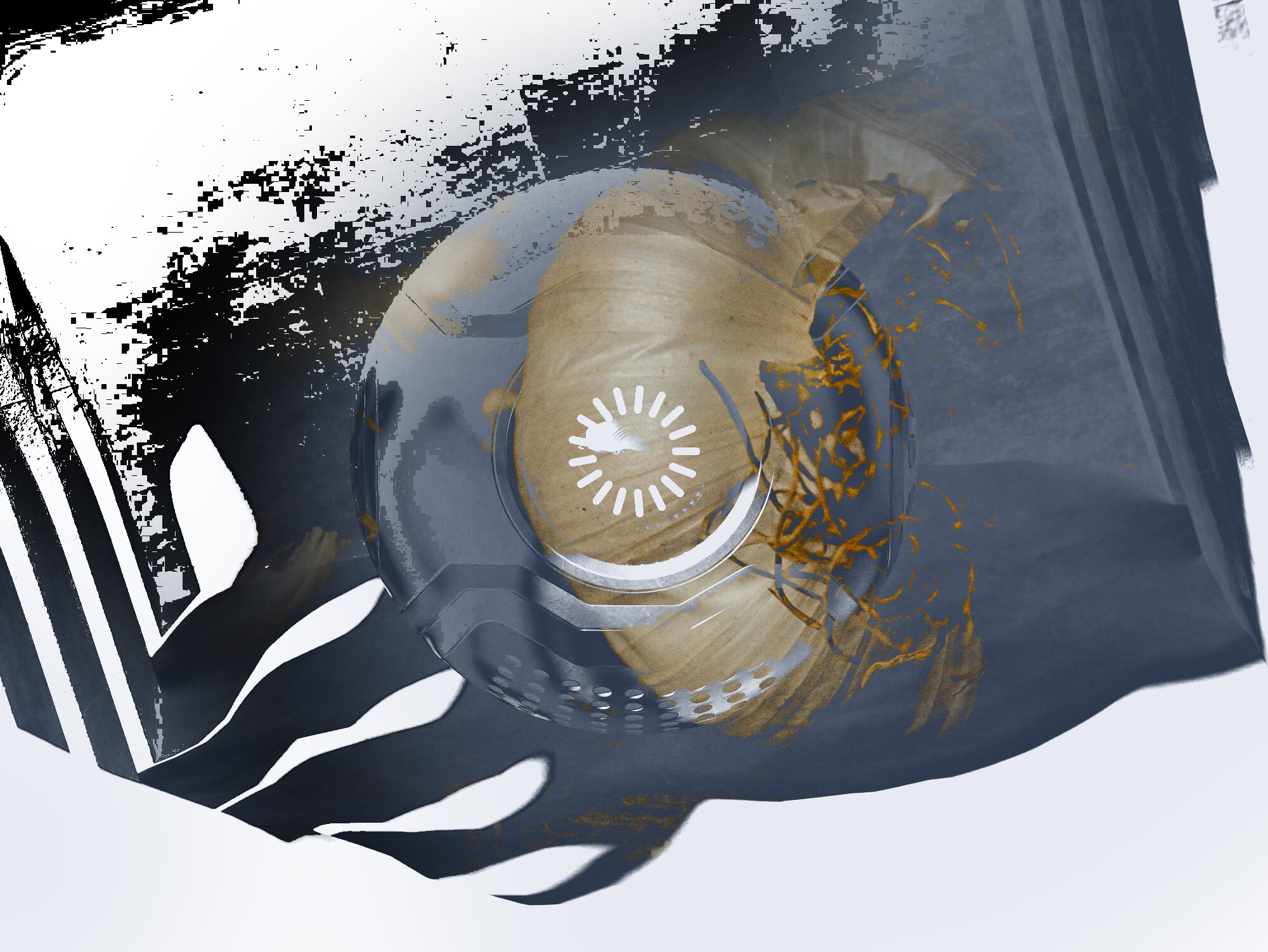
A white van, a few crates of vegetables, and a man running circles around the vehicle. A small device hovers above him. It drops lower when he crouches, changes direction when he does, patiently searching for an angle of attack. It does not look like bombing. It looks like a hunt.
The man's name is Yuri. He is 52 years old and had come to Kherson to sell vegetables. When he heard the buzzing, he was holding two heads of garlic. He raised them toward the drone's camera, then pointed to the tomatoes, cucumbers and eggplants scattered around his stall. He was trying to explain that he was not a soldier. That there were no positions there, no weapons, no cleverly disguised military operation. Just vegetables. The drone kept following him, slipped beneath the market umbrella and exploded beside the van. Yuri survived with a concussion and shrapnel wounds to his legs and back.
There is something almost unbearable condensed into that gesture with the garlic. A man is trying to reason with a projectile. Or, more precisely — we assume — with another human being watching him through the projectile's camera. But then again, perhaps there is no one on the other side at all. Perhaps he is staring directly into the face of a cold machine calculating in real time: kill, do not kill, how to kill, which part of the body to aim for...
Perhaps he really is trying to reason with a vampire — a metallic one, a new breed immune to the ancient methods of driving monsters away, whether with garlic or with reason.
Remote warfare is nothing new. For centuries, human beings have tried to increase the distance between the person doing the killing and the person being killed. The bow was an advance over the sword, the cannon over the bow, the bomber over the cannon. Throughout that history, distance has also served as psychological protection for the killer. It is easier to fire a shell at a coordinate than to look into the face of the man whose legs it is about to tear off.
The FPV drone alters that relationship in a strange and horrifying way.
Industrial warfare often made killing anonymous. This technology restores its intimacy, but without the danger that once came with physical proximity. This is no duel. One person can see everything; the other can see almost nothing. One controls the camera and the explosive charge. The other is left trying to guess which bush death will emerge from.
The drones used around Kherson are often small commercial devices modified to carry explosives. Many are no more than forty centimetres across. They can weave between structures, chase vehicles and transmit a live image to an operator who may be tens of kilometres away.
These are scenes of horror from the Ukrainian battlefield, but they are also scenes from our collective reality. Because this precision hunting of an individual human being is no longer a capability reserved for a superpower armed with million-dollar missiles. It can be carried out with a small aircraft assembled from commercial components, a handheld controller and an explosive charge.
Technological optimism once liked to show us drones delivering medicine to remote villages. The same platform now delivers explosives into the face of a man selling eggplants.
Perhaps part of the problem is that we have grown accustomed to following war like a set of sports statistics. This many drones were launched. This many were intercepted. One side advanced two kilometres. The other struck a warehouse. A red line moved on a map. Then comes the weather forecast, the price of oil and a video of a dog seeing snow for the first time.
That does not mean we have become worse people. The human nervous system simply cannot absorb images of destroyed homes and dead children for years on end without constructing some form of psychological shield. Apathy is sometimes a defence against an unbearable excess of pain.
But a defence can easily become a habit, and a habit can become a political problem.
Because systems that produce violence prefer nothing more than an audience that feels it has already seen everything. They do not need our approval. It is enough that we stop reacting. That we watch the video to the end, feel a brief flicker of discomfort and move on. The creeping dystopia is already underway, and by the time it reveals itself in all its horror, it seems we may already be entirely accustomed to it.
The footage from Kherson, for a moment at least, breaks that steady progression of acceptance. Someone watching it has to say: "For God's sake, what is this?" Ideally, that would be everyone's reaction, although perhaps it is already too late for such optimism. For some, this will be nothing more than fascination — the thrill of watching something that resembles a video game, except it is no longer a game. Someone whose mind has already gone sufficiently dark will think how exhilarating it would be to hold the controller and blow people apart from a safe distance.
Behind the controls, apparently, there is still a human being. But that is no comfort. It is an indictment — perhaps one that reaches far beyond the individual, the military or the states at war. The fact that we have reached a point where we can simply sit and watch this is an indictment of a species moving in this direction at all.
An algorithm could, if it has not already, one day take over the tracking, identification and selection of targets — although human beings have already demonstrated that mechanised sadism does not require a machine uprising.
The most dangerous response to all of this would be to shrug and say that war has always produced new ways of killing. It has. But it does not follow that we are obliged to accept every one of them — or any of them.
Technology does not simply happen to us like a storm beyond our control. Societies decide what they will produce, what they will sell and which acts they will define as crimes even when those acts are technically possible. We tried to create an international taboo around chemical weapons. Much of the world has banned anti-personnel mines. Those rules have not prevented every use, but they have established at least some kind of boundary — a moral boundary, if nothing else.
What is needed is a revolt against the very language that turns horror into technological progress. That is where resistance begins. By refusing to call the hunting of human beings the new normal. By refusing to accept a future simply because technology has made it possible. Otherwise, sooner or later, in one form or another, we may all find ourselves face to face with some machine that, in one form or another, holds our lives in its hands.
Comments